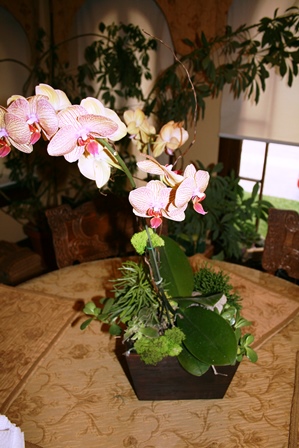
Elegant orchids light up your home with their stunning colors and graceful growth habits. But how hard is indoor orchid care? While some rare orchids are challenging to grow indoors, phalaenopsis thrive as houseplants.
Commonly known as moth orchids because the flowers perch along a stem resembling moths in flight, phalaenopsis possess long sprays of 2- to 6-inch-wide flowers that come in a variety of colors, including white, lavender, pink, yellow, green and hybrids with splotches and spotting. Some phalaenopsis orchids even feature fringed flowers.
Phalaenopsis tend to bloom spring through fall, but in the right indoor garden conditions, they can flower year-round. These orchid flowers last for two to three months at a time.
Phalaenopsis origins
Originating in the jungles of the Philippines, phalaenopsis orchids do well in temperatures ranging from 62 to 85 degrees F. Since they grow in their natural habitat under the jungle canopy, they are accustomed to bright shade but no direct sunlight, which is easy to replicate indoors.
To enjoy months of blooms from your moth orchids, keep the following phalaenopsis orchid care growing tips in mind.
Where to locate your moth orchid
Phalaenopsis thrive in bright indoor growing locations that don’t receive any direct sunlight. Be especially careful to keep moth orchids away from hot midday sun. Also avoid placement in drafty areas, as sudden changes in temperatures can cause bud or flower drop.
Good locations for growing orchids are bright bathrooms, eastern windowsills and under full-spectrum lighting. You can tell if a phalaenopsis is receiving the right amount of light by its leaf color. Dark green leaves mean too little light, and light yellow leaves signify too much light. Yellowish-green leaves indicate the right amount of light.
(Photo, Healthy Houseplants.com)
Water your phalaenopsis correctly
Moth orchids are accustomed to rain and moisture, so keep the bark slightly moist. When you water orchids will depend on the season and conditions in your home. During hot, dry weather, phalaenopsis require watering every two to three days, whereas in moist, rainy conditions, they may not need a drink for two weeks. When the bark becomes lightweight, it’s time to water.
Watch for orchid crown rot
Phalaenopsis are epiphytic plants that naturally grow upside down suspended from trees. Indoors, they are cultivated in bark simply to keep them erect. By growing them against their nature, they become susceptible to crown rot. Prevent this potentially deadly infection by avoiding watering the crown at the base of the plant, and never leave the plant in standing water.
Provide phalaenopsis humid conditions
As jungle plants, moth orchids require moist air. Create a humidity tray for your orchid by filling a waterproof tray with pebbles, gravel or marbles and adding water to just below the surface. Place the phalaenopsis container on top. The evaporation of the water will create humid conditions surrounding the plant.
Fertilize orchids regularly
Feed phalaenopsis once a month with an orchid fertilizer. Under-fertilizing will lead to poor flowering and too much can burn roots.
Prune spent orchid blooms
Once a flower stalk stops blooming, get another flower stalk in about three months by cutting in between the third and fourth node from the base of the plant. When that new stalk finishes blooming cut the flower stalk off at the base. You’ll get another flower stalk in three to four months. Keep repeating the process.
If your orchid fails to bloom, give it nighttime temperatures of 50 to 55 degrees and daytime temperatures of at least 75 degrees. You should see a flower spike in about a month.
Let orchid roots crawl
Phalaenopsis have roots with a spongy outer material that absorbs water from the air. In nature, they crawl over trees, so let them make their way out of the container.
Repot orchids regularly
Give moth orchids new bark every one to two years. Avoid letting the bark decompose, which can kill roots. Soft, decomposed bark indicates a need for repotting. Repot when the plant is not in bloom.
Watch for orchid pests
Mealybugs find orchids attractive. Spray the invaders with 70% isopropyl alcohol, and then rinse the pests off with a strong spray of water.
 Healthy HouseplantsJune 9, 2013